If you locate a run-on sentence and find where the two independent clauses "collide," you can decide how best to separate the clauses. Fixing run-on sentences is very similar to fixing comma splices. You can make two complete sentences by inserting a period. You can use a semicolon between the two clauses if they are of equal importance; this allows your reader to consider the points together. You can use a semicolon with a transition word to indicate a specific relation between the two clauses; however, you should use this sparingly. You can use a coordinating conjunction and a comma, and this also will indicate a relationship.

Or, you can add a word to one clause to make it dependent. Once you discover where the two independent clauses are "spliced," there are several ways to separate them. You can use a coordinating conjunction following the comma, and this also will indicate a relationship. For additional information on coordinating conjunctions, click HERE.

See the note BELOW regarding the use of a comma between two independent clauses when the second independent clause begins with a parenthetical element or adverbial clause. The word but is one of seven words that are referred to as coordinating conjunctions. One key rule of grammar is that coordinating conjunctions that link independent clauses must have a comma before them. If a coordinating conjunction is linking anything else, it doesn't need a comma. A compound sentence contains two or more independent clauses linked by a coordinating conjunction. Independent clauses are those that can stand alone as complete sentences.

The most common coordinating conjunctions are and, but, and or. In certain cases, nor, yet, so, and for act as coordinating conjunctions. The words for, and, nor, but, or, yet, and so are the seven coordinating conjunctions. However, coordinating conjunctions don't use commas all of the time. If a coordinating conjunction is connecting something besides independent clauses, it doesn't need a comma. In this case, a semicolon may replace the comma.
Punctuation and grammar rules state that two independent clauses connected with a conjunctive adverb cannot be joined with only a comma. The semicolon is strong enough to hold them together, and the full stop of the period is powerful enough to break the clauses apart. To combine two complete sentences/ independent clauses, you have two options. You can use a comma with a conjunction, or you can use a semicolon. If you use a comma and conjunction, the acronym FANBOYS will help you remember the conjunctions .

If you use a semicolon, you do not have to capitalize the first letter of the next sentence. An independent clause is a unit of grammatical organization that includes both a subject and verb and can stand on its own as a sentence. In the previous example, "I went running" and "I saw a duck" are both independent clauses, and "and" is the coordinating conjunction that connects them. Contending that the coordinating conjunction is adequate separation, some writers will leave out the comma in a sentence with short, balanced independent clauses . If there is ever any doubt, however, use the comma, as it is always correct in this situation.

A subordinating conjunction is a conjunction that connects an independent clause with a dependent clause. A subordinate clause cannot stand by itself, and unlike coordinating conjunctions, subordinating junctions do not follow commas. Subordinating conjunctions can be tough to understand and are probably a major reason for the confusion surrounding commas and conjunctions.

Does So Always Need A Comma If you need help understanding subordinating conjunctions, we have a great guide to them. As a conjunctive adverb, however is used to join two independent clauses to form a compound sentence. An independent clause is a clause that could stand alone as a complete sentence. The "however" introduces a contrast or opposition between two independent clauses.
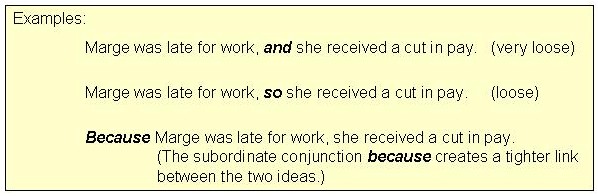
As you can see, both phrases make sense on their own, and can stand along as complete sentences. In this scenario, we have two independent clauses, therefore you must use a comma beforebut. "She likes the red ones best" has a subject, verb, and object.

It is possible to write, "She has three pairs of shoes. She likes the red ones best." Instead of writing the two sentences separately, we can join them with a coordinating conjunction. If the word is restrictive, commas should not be used; if the word is nonrestrictive, commas are required. A group of words that can easily serve as a separate sentence is called an independent clause.
A comma indicates a pause between the ending of an introductory word, phrase, or clause, and the beginning of the main part of the sentence. The most common introductory word groups are clauses or phrases which function as adverbs, telling how, why, when, where, or under what conditions something happened. Other introductory elements may include prepositional phrases, adjective clauses or phrases, participial phrases, infinitive phrases, and transitional expressions. Many writers forget to put a comma before the word as when one is needed (or they use a comma when they shouldn't).

Writers tend to make this mistake when forming sentences in which as separates two independent clauses. When I started teaching at the University of Delaware some years ago, I was positively gobsmacked by the multitude of comma splices that confronted me. Coordinating conjunctions are conjunctions, or joining words, that are placed between words and phrases of equal importance. Used with coordinating conjunctions, commas allow writers to express how their complete thoughts relate to one another. They also help avoid the choppy, flat style that arises when every thought stands as a separate sentence. Though not necessarily mechanical, the use of commas in lists is well established.

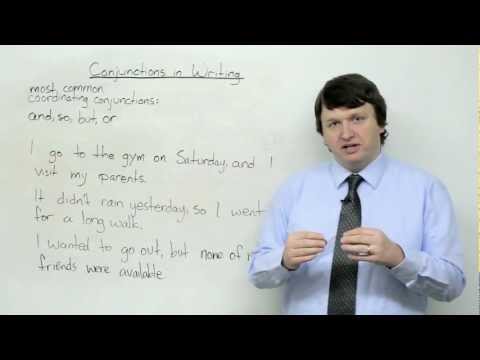
In this usage, the comma separates a series of words, phrases, or independent clauses. Commas can be used to separate independent clauses, but with the addition of a coordinating conjunctions . The seven coordinating conjunctions are for, and, nor, but, or, yet, and so. If any of these seven words are connecting independent clauses, they must have a comma before them. As you may recall from above, an independent clause has a subject and a verb and can stand on its own as a sentence. Often, a coordinating conjunction will connect two independent clauses — like the word "but."

Similarly, you must insert a comma after "so" when you use it as a coordinating conjunction to combine two independent clauses into one sentence. The combination of two independent clauses with the help of so denotes a cause-and-effect relationship. When you use a conjunctive adverb to join two independent clauses , precede the adverb with a semicolon and follow it with a comma. You appear to be referring to one sentence, not two, where the single sentence contains two independent clauses joined by however, not However. It is also preferable to use a comma after these words and terms." Therefore, use a semicolon before however and a comma after.

A comma is needed before "so" when it's acting as a conjunction to bring together two independent clauses. An independent clause is a complete thought with its own subject and predicate. In this situation, each clause is equal in weight, and neither clause is dependent on the other to make sense.

Some conjunctive adverbs can be used for transition, as an introductory word, or for conversational purposes. If the conjunctive adverb does NOT function by combining complete sentences, set it off with commas. Since "that's funny" is a complete sentence, it could end with a period.

You could also use a semicolon in place of the period since there is no conjunction. But some writers would retain the comma since the two clauses are so closely related. "That's funny" acts almost as a dependent clause or phrasal adverb in this sentence. When these words join two independent clauses they are known as adverbial conjuncts because they are adverbs acting as conjunctions. Though some writers rebel against this rule and surround their conjunctive adverbs with commas, most still prefer the significant pause the semicolon or period offers. When you give someone a choice between two things, you don't need to use a comma after "or." For example, "Would you like Coke or 7Up?

" The comma is needed when there are two independent clauses joined together by a coordinating conjunction like the ones in this lesson. Another possibility is that a writer is punctuating by ear, relying on the old idea that you put a comma where you take a breath. Since but signals a disjunction, a writer might imagine a pause and insert a comma on that basis. But punctuation is not determined solely by pauses heard in our mental ear.

If pausing is the basis for the comma after but, we are dealing with a false underlying assumption leading to an error. The comma functions as a tool to indicate to readers a certain separation of words, phrases, or ideas in order to prevent misreading the writer's intended meaning. When a sentence is spoken aloud, a comma often represents a pause, which in verbal conversation functions to clarify meaning. The comma is used according to specific rules that relate to grammatical structures within the sentence. Consistency in the use of commas allows the reader to be assured of proper interpretation of the writer's intentions. Semicolons (;) Semicolons are used to connect two independent clauses and to separate items in complex lists.

In each of the examples above, the two parts of the sentence separated by the comma could stand as full sentences by themselves. A compound sentence contains more than one independent clause. The clauses can be joined by a semicolon, a colon, or a coordinating conjunction . There should be commas after the words fathers and bosses.

You would not say "these experiences produce different conscioiusness." Perhaps you could reword to levels of consciousness. Our Dashes rule says, "Use an em dash sparingly in formal writing." You could use parentheses instead. Somewhere back in the day, teachers must have taught us to include a comma after coordinating conjunctions used at the beginning of sentences, because many of us include them. Actually, most of the time you can skip the comma after an opening coordinating conjunction. Writers can give readers information that limits or otherwise modifies a main idea that follows.

To do so, writers can use introductory words or introductory phrases. These introductory elements can be one word or several. Common introductory elements include transition words and statements about time, place, manner, or condition. A complex sentence contains an independent clause and one or more dependent clauses. A dependent clause, unlike an independent clause, cannot stand on its own as a complete sentence. The conjunctions and prepositions most commonly used to introduce a dependent clause include if, because, while, as, although, since, and unless.

Click on the commas for further explanation of the rules of comma usage being used. If your computer is equipped with PowerPoint, click on the PowerPoint icon to the right for a brief PowerPoint presentation on comma usage. Use a comma to separate the elements in a series , including the last two.

"He hit the ball, dropped the bat, and ran to first base." You may have learned that the comma before the "and" is unnecessary, which is fine if you're in control of things. However, there are situations when, if you don't use this comma , these last two items in the list will try to glom together . Using a comma between all the items in a series, including the last two, avoids this problem. This last comma—the one between the word "and" and the preceding word—is often called the serial comma or the Oxford comma. In newspaper writing, incidentally, you will seldom find a serial comma, but that is not necessarily a sign that it should be omitted in academic prose.

Two commas can be used to set off additional information that appears within the sentence but is separate from the primary subject and verb of the sentence. Sometimes called a "parenthetical expression" or an "aside," this information interrupts the main thought to add an additional comment. Occasionally, the interrupter won't actually interrupt the main thought. In that case, it's preceded by a comma and followed by a period. Meanwhile, a comma after so is essentially inserted when it is used as a coordinating conjunction combining two independent clauses denoting a cause-and-effect relationship.

To combine two independent clauses , use a semicolon or a comma and conjunction. Use a comma before a coordinating conjunction to join two independent clauses. If the independent clauses are short and well-balanced, a comma is optional.

When a coordinating conjunction joins two independent clauses, a comma is used before the coordinating conjunction . When you have two complete sentences—with two subjects and two verbs—you need more than a comma to separate them. You must join them either with a comma and a conjunction or with a semicolon, or you can make them two separate sentences.

Joining two complete sentences with a comma is called a comma splice. When a verb immediately follows an introductory element, however, don't use a comma. Such a case occurs if the introduction is serving as the subject of the sentence or if the sentence uses inverted word order. A comma is also sometimes optional after certain prepositional phrases. You can tell if you need a comma by whether you pause while reading the introductory element out loud. Include commas after coordinating conjunctions that start sentences only when a nonessential phrase or a parenthetical follows the conjunction.

Both clauses are independent and could stand on their own as complete sentences. When they are joined in the same sentence, however, they must be connected with a comma and a coordinating conjunction. When joining two independent clauses, or clauses that could stand on their own as full sentences, place a comma before the conjunction. If the second independent clause is very short, or if it is an imperative, the comma can be omitted. Commas are necessary before a coordinating conjunction that separates two independent clauses. A comma marks a slight break between different parts of a sentence.

Used properly, commas make the meaning of sentences clear by grouping and separating words, phrases, and clauses. Many people are uncertain about the use of commas, though, and often sprinkle them throughout their writing without knowing the basic rules. When you're writing a list of nouns, verbs, or any other part of speech, you'll need to include commas to separate them. The same goes for a list of phrases and clauses.


